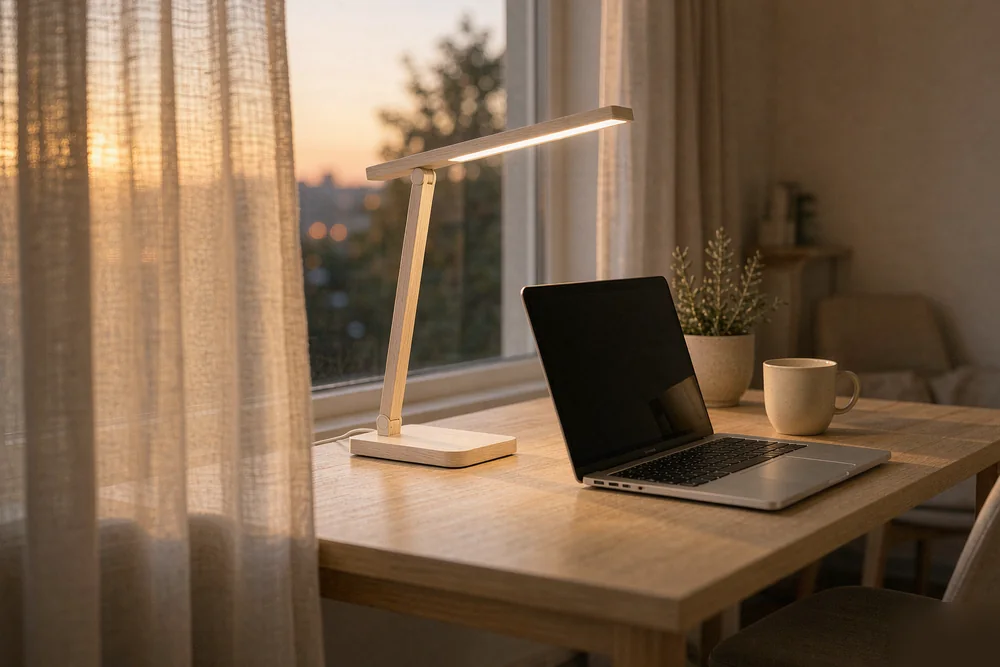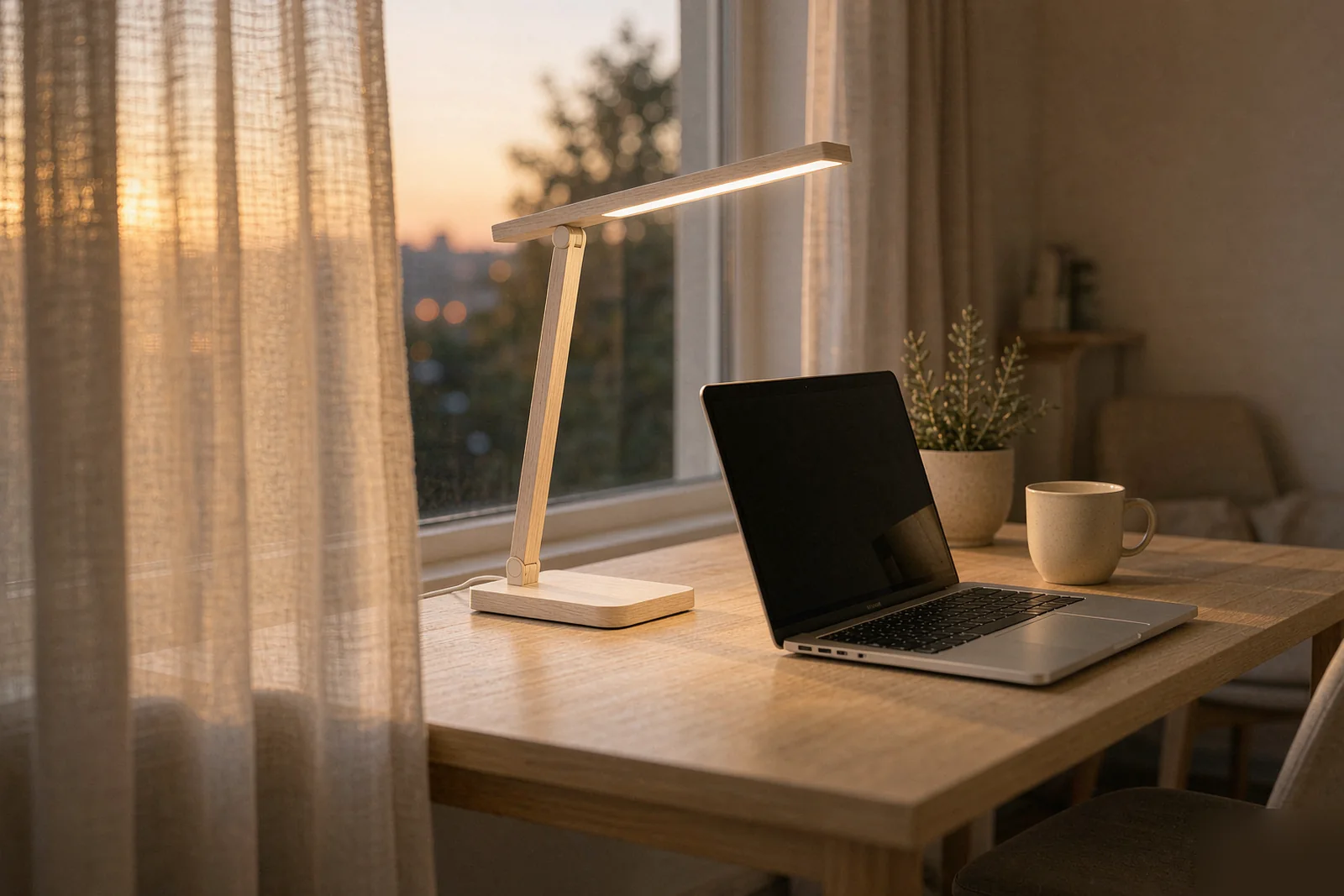
The first Aurora prototype looked fine. It was bright, it was adjustable, and it gave three of our five testers a headache within a week.
We had measured the wrong things. Lumens were fine. Colour temperature was fine. What we had not measured was flicker — the 120Hz ripple that most low-cost LED drivers produce when they convert AC to DC without adequate smoothing.
What flicker actually is
LEDs do not glow steadily; they switch on and off extremely fast. A cheap driver lets the 50/60Hz mains ripple through, so the light pulses 100–120 times per second. You will not consciously see it. Your retina still registers it, and your brain spends the afternoon processing the strobe.
Studies on visual fatigue consistently link high-flicker light with faster onset of eye strain, particularly in tasks that require sustained near focus. That is exactly what a desk lamp is for.
The fix: a constant-current driver
We moved to a constant-current driver switching at 42kHz — roughly 350× faster than the ripple we were trying to remove. At that frequency, the modulation is far beyond what the human visual system can resolve, and it disappears from slow-motion camera footage too.
The cost was not trivial. The driver alone added about $3.40 to our bill of materials, which at our volume is the difference between a $39 lamp and a $49 lamp.
Then we diffused it twice
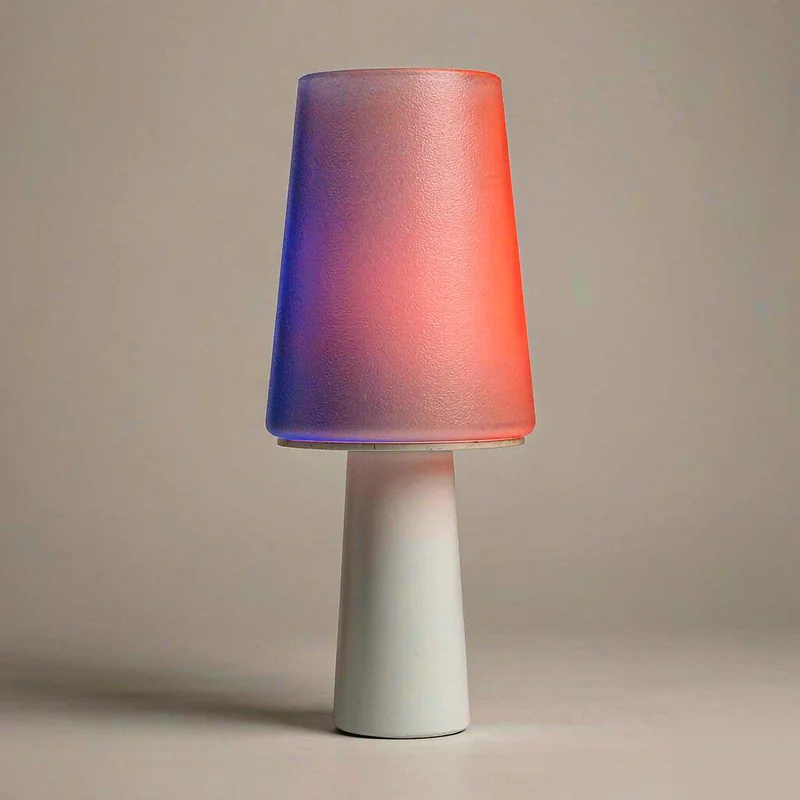
A flicker-free LED is still a grid of bright points. We put a 1.2mm diffuser directly over the LEDs, then a second 0.8mm panel with a slight texture. The result is a light source with no visible hotspots and a measured uniformity of 0.82 across the panel — a number we are slightly obsessed with.
If you can see the individual LEDs in a lamp, the lamp is not finished.
What we gave up
Cost, mostly. And a little brightness: double diffusion eats about 12% of the output, which is why Aurora is 800 lumens rather than 900. We think that is the right trade for a light you sit under for four hours.
We also removed the app. A lamp that depends on a server is a lamp that stops working when the company does.
How to check any lamp, including ours
Open your phone camera, point it at the lamp, and look at the screen. If you see rolling dark bands, the lamp flickers. It is a crude test, but it is the same one we use in the factory.